
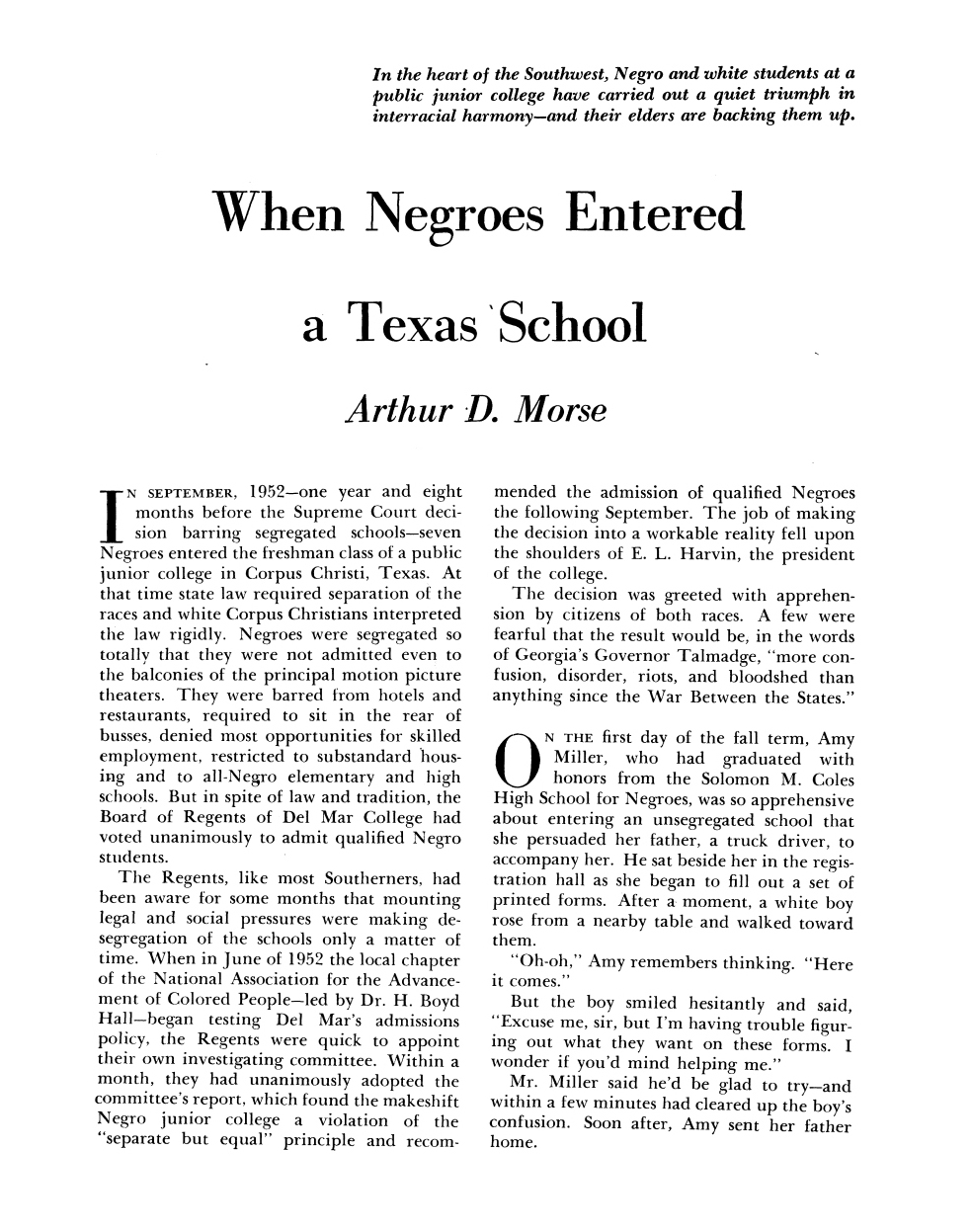
Two years before Brown v. Board of Education mandated desegregation, Del Mar College voluntarily desegregated in 1952.
Del Mar was founded in 1935 and in the late 1940s a separate campus for African American students at Solomon Coles high school was established, called Coles Junior College. The school was in the segregated area of Corpus Christi, which was the Washington-Coles neighborhood on the north side of the city.
At that time, the Supreme Court’s decision in Plessy v. Ferguson stated separate facilities among different races were constitutional if equal.
“The idea that these schools or any of those other facilities were equal was an absolute fiction,” said Del Mar history professor Mark Robbins.
In a podcast with KEDT, Robbins explained the number of classes offered was much lower, and if there were fewer students in attendance the course offerings were not the same.
By the 1940s Del Mar was expanding, with the addition of the Memorial Classroom Building that had new administrative offices, science labs and a library.
African American students did not have access to these facilities proving they were separate but not equal. The conditions there were described as deplorable according to the son of President E.L. Harvin.
H. Boyd Hall, a Corpus Christi dentist and executive secretary of the local chapter of the National Association for the Advancement of Colored People, argued that Coles Junior College facilities were separate but not equal.
“Coles Junior College has no adequate library or laboratory facilities and inadequate staff. In addition, the curriculum is very limited at the school,” Hall said in a June 4 article in the Corpus Christi Caller-Times.
The first three applicants were Clifford Vernell Smoots, Jo Ann Lawson, and Willie Andrew Miller, who all attempted to enroll in summer classes in June 1952. Lawson attempted to enroll first, wanting to take a music class due to the lack of a music course at Coles. Smoots wanted to take building construction or mechanical drawing, and Miller sought admission for a course in carpentry or mechanical drawing.
When Del Mar refused to enroll these students, Hall sent a letter to the Board of Regents requesting they let them present their case, threatening to sue if turned away.
In July of 1952 the Board of Regents voted unanimously to admit any qualified black students that attended the junior college.
This decision was made after a committee composed of John F. Lynch, Harvey Weil, and V.G. Woosley made an on-the-spot survey of Coles Junior College to see if it was equal to Del Mar College.
The committee cited four points where Coles Junior College was not equal to Del Mar, and desegregation was effective that September.
According to the Caller-Times, the transition went smoothly, and teachers made no attempt to differentiate between students and said they had no special problems because of the new system.
Both faculty and students really had “great attitudes” toward the small group of Black students enrolled according to Lavernis Royal, one of the first seven Black students who enrolled. They were accepted into classes and on campus, though they were barred from nearby restaurants and drive-ins, Royal said in a May 1972 Caller-Times article about the integration.
The overall community was very accepting of this integration, and the younger generation made it clear they didn’t want to carry on what their previous generation believed in.