
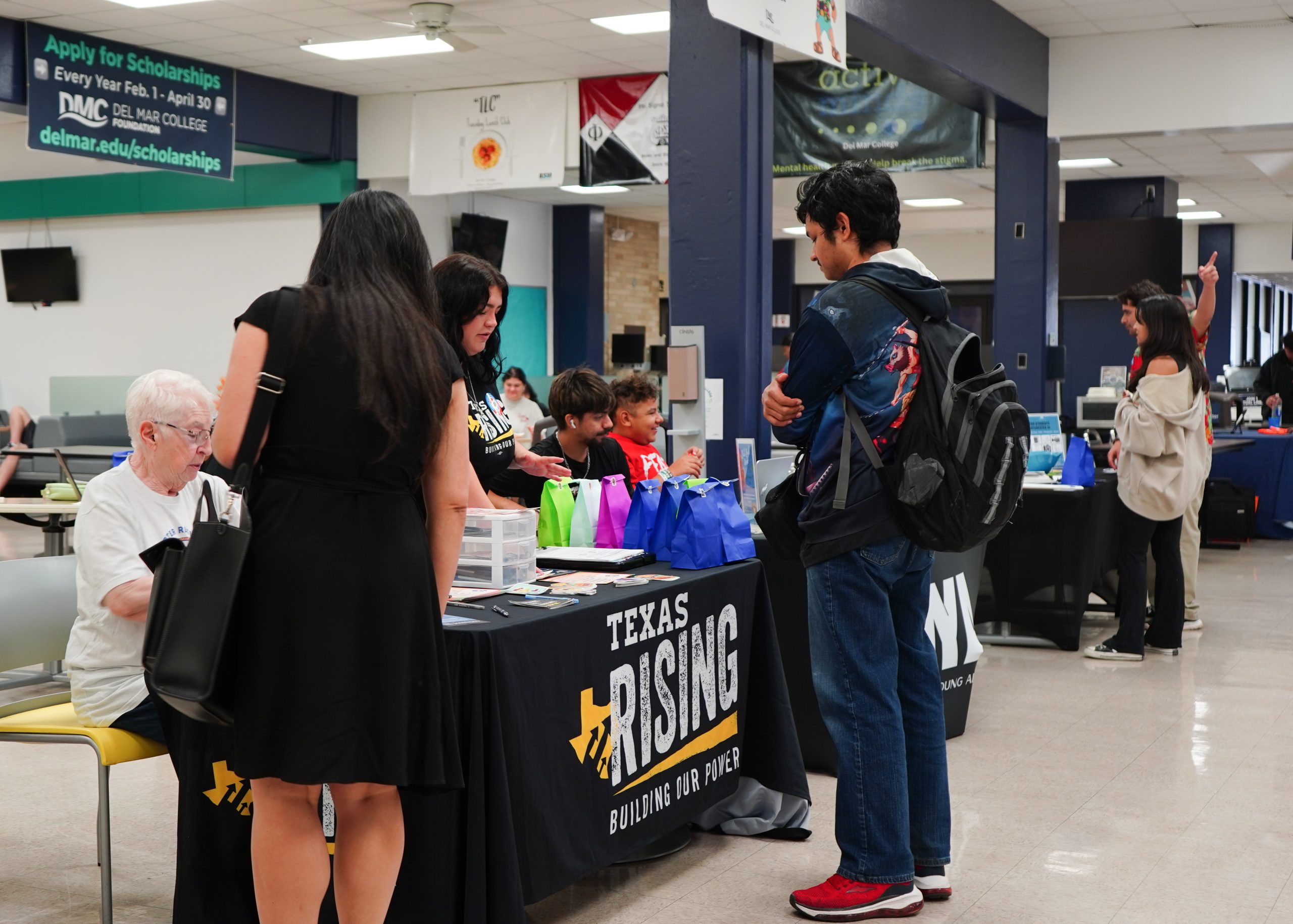
Student organizations had the opportunity to recruit new members and promote club involvement during Club Rush Week across all Del Mar campuses Sept. 14-18. The event gave students the opportunity to connect with campus organizations, find a community, and engage with important social, religious, and professional growth opportunities. The event, held every semester, serves as a hub for peer-to-peer networking and provides a structured pathway for students to either join existing organizations or launch entirely new ones through the Student Government Association.
Club Rush Week is important in student development since it links academic and social life together. Organizers emphasize that finding a supportive environment is crucial for navigating the many personal or educational challenges students face.
“Community is so important inside of education and outside of education,” said Arianna Rios, campus organizer for Texas Rising. “This gives you an opportunity to branch out and meet new people.” Administrative Assistant Rachel Aguilar shared the same sentiment, that the primary function of Club Rush Week is “to gain traction and promote the club,” while serving as a venue where students can “find your tribe, find your people, find your group.”
Beyond social connection, the event serves as a starting point for future career success. Mascot Specialist, Anna Williams, highlighted the long-term professional benefits of campus involvement. She advised students to join clubs aligned with their majors, but also to seek out organizations that “make you a better person, kind of round you out a little bit more.” Williams added that whether students choose standard clubs or professional fraternities and sororities, active participation signals high capability to future employers.
A main focus of this semester’s Club Rush was social justice and civic engagement with multiple organizations addressing critical issues like voting rights and gender rights. Among the most active groups present was the Del Mar chapter of Texas Rising, a nonpartisan student organization under the umbrella of the Texas Freedom Network. The organization focuses heavily on breaking down complex local and state voting laws to get younger people into voting and make the process more accessible. This year, the club is running a series of voter registration drives.
For students focused on science fields, the Natural Sciences Club offered a hands-on look into practical applications of their coursework. Represented by student leaders Noah Salamah, Dylan Garcia, and Nayah Macaambac, the club covers chemistry, biology, biotechnology, geology and other sciences.
According to the group, the club is tailored mostly for science or allied health majors who want to see “science in-action” and gain “hands-on experience.” Macaambac highlighted past experiential learning trips, noting that during the spring semester, the club visited the Aransas National Wildlife Refuge, where a tour guide showed them a pack of wild javelinas, whooping cranes, and a bunch of birds.
Currently, the club is organizing a fall fundraiser and hosting “BioBlitz,” an event that brings together students, faculty, and local citizen scientists to record as many living species as possible within a designated timeframe, utilizing the iNaturalist app.
Other organizations present for Rush Week included religious and spiritual groups like the Baptist Student Ministry and the HYA Bible Club, alongside politically active chapters such as Turning Point USA and Texas Rising. Professional and advocacy groups also maintained a heavy presence, including the Del Mar Press Club, which connects aspiring journalists to local media opportunities, and the American Association of University Women, which advocates for gender equity and rights on campus.
For students who did not find a niche among the existing tables, SGA-aligned staff members like Aguilar were available to discuss the process of launching a brand-new club. While starting an organization allows students to pioneer unique campus niches, staff noted that it requires commitment from the founders. Students who turn in all their paper work, schedule risk management training, and engage with the club and SGA staff reap benefits of being an official club including access to meeting spaces and funding opportunities.